
Revealed: The best and worst places in the North East for food hygiene ratings as region claims second place in the national rankings
The towns and cities across the North East that score highest and lowest for their food hygiene ratings have been revealed, thanks to a report from online training provider High Speed Training, marking 15 years since the introduction of the Food Hygiene Rating Scheme.
- Stockton-on-Tees, ranked 1st in the North East, has the highest rating of 4.89. The change in rating from 2024 was an increase of 0.03.
- Newcastle upon Tyne and South Shields (ranked joint 6th) have the lowest rating of 4.47. Their respective changes in rating from 2024 were -0.04 and +0.06.
- Sunderland, which is now ranked 4th, had the biggest improvement in ranking and moving up 3 positions from its 2024 rank of 7th.
- Sunderland also had the biggest improvement in rating, climbing 0.14 to a score of 4.63.
- Darlington (ranked 3rd) and Gateshead (ranked 4th) had the biggest drop in ranking, both moving down 1 position from 2024.
- Darlington (ranked 3rd) and Newcastle upon Tyne (ranked 6th) shared the biggest decrease in average rating, with a drop of 0.04. Their average ratings in 2024 were 4.83 and 4.51 respectively.
- Across the region, there were 9,667 premises analysed. This is an increase of 103 from 2024.
- 16.8% of takeaways and sandwich shops in the North East scored 0, 1, 2, or 3.
- Across the region, 6 premises scored a 0 and 73 premises scored a 1.
- The total number of premises scoring a 0, 1, 2, or 3 was 867.
- 91.0% of all premises in the North East scored a 4 or a 5.
- 92.5% of restaurants, cafes, and canteens in the region scored a 4 or a 5.
- Overall region change: 2025: 4.64 - 2024: 4.62
- View the report with interactive map
- Infographics download
The report, which analysed Food Standards Agency (FSA) data for over 240,000 food businesses across England, Scotland, Northern Ireland and Wales, found that in the North East, the average food hygiene rating across all food establishments was 4.64 from 9,667 premises, which places the region joint 2nd in the national rankings.
A similar report run in 2024 by High Speed Training calculated the North East score at 4.62, showing that food hygiene standards have improved across the region in recent years.


The top spot in the North East went to Stockton-on-Tees, with an impressive average score of 4.89 from almost 300 premises, placing them joint third in the national rankings for towns and cities.
Hartlepool, with a 2025 score of 4.84, is now ranked 2nd in the region, seeing a slight improvement from its 2024 rating of 4.83.
The biggest improver in the region was Sunderland, who increased their rating by 0.14 from 2024. Their average score of 4.63 now places them 4th in the region.
The lowest average rating in the region is now shared by Newcastle upon Tyne and South Shields, who both have an average score of 4.47.
In the Tyne-Wear derby, Sunderland has overtaken Newcastle, with an overall average rating of 4.63 vs 4.47, ranking them 4th and 6th respectively. The biggest fall in ratings was shared by Newcastle and Darlington, who both saw their average ratings drop by 0.04.
High Speed Training’s report also found that 16.8% of takeaways across the region scored 3 or below for their food hygiene rating, whilst 91.0% of all businesses scored a 4 or a 5.
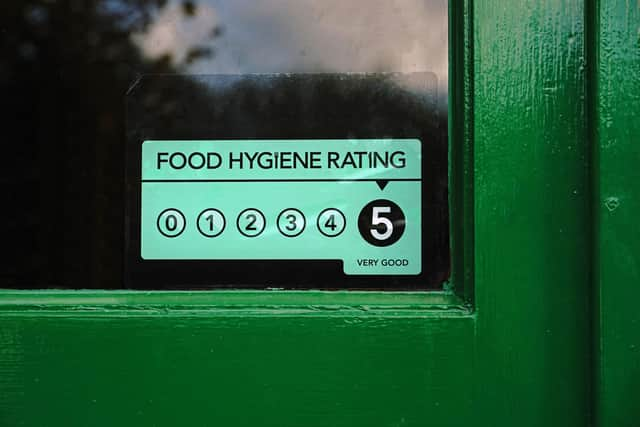
The Food Hygiene Rating Scheme (FHRS) is a partnership with local authorities in England, Wales and Northern Ireland that was launched in 2010. It replaced a number of regional schemes, with the aim of providing hygiene information clearly and more effectively across the UK. Following regular inspections, ratings are devised based on the standard of food handling hygiene, the physical condition of the premises and facilities and food safety management practices.
These ratings are then made available on the Food Standards Agency (FSA) website and are usually visible from outside of the premises, often presented in a window near the entrance. In Wales and Northern Ireland, it is compulsory for businesses to display their food hygiene rating. However, in England it is currently just considered best practice.

Paul Turner CEnvH, MCIEH, an Environmental Health Officer for North Yorkshire Council, said: “Since its inception 15 years ago, the Food Hygiene Rating Scheme has played a pivotal role in improving standards across the UK. It has been incredibly successful in allowing local authorities and EHOs to effectively engage with both businesses and consumers to communicate important messages around food hygiene and safety.
“Prior to the launch, a number of regional ‘Scores on the Doors’ schemes existed that, though they were effective, didn’t easily allow for national comparison and benchmarking. A national standard means greater consistency for businesses and provides the public easy access to this vital information.
“However, we would welcome some updates to the FHRS to make it more suitable for the current landscape, which relies heavily on food delivery apps and aggregators. We would like to see this information displayed more prominently across these apps, perhaps with a traffic light system for easy identification.
“We are also always pushing to make the display of food hygiene ratings in England mandatory, as it is in Wales and Northern Ireland, to ensure that consumers have all the information they need to make informed choices about where to spend their hard-earned money.”

Dr Richard Anderson, Head of Learning and Development at High Speed Training comments: “Food safety and robust hygiene practices should be of paramount importance to food businesses, and to the customers who use them. 15 years have passed since the launch of the Food Hygiene Rating Scheme, and its place in the industry is as vital as ever. These ratings are a direct reflection of how safely and hygienically that establishment operates, and we urge businesses and customers to take them seriously.
“For businesses that perform well, a high rating is a real selling point. However, establishments with a low hygiene rating can be extremely off-putting for customers, which ultimately have a significant impact on reputation and profitability.”
“Our report shows that, on average, standards remain high across the UK, and have improved from 2024. This commitment to correct food hygiene training for staff, alongside robust food management procedures and everyday good practices are crucial to keep performing at high standards.
“We would also urge customers to check the food hygiene ratings of establishments they wish to dine at, so that an informed call as to whether you eat there can be made.”
To view the report in full, and to see how your area compares to others, please visit www.highspeedtraining.co.uk/hub/food-hygiene-ratings-report.