
Planning inspector's decision on new 59,000-panel Springwell Village solar farm to power 11,000 homes
Controversial plans for a solar farm on the outskirts of Sunderland have been thrown out at appeal by a Government-appointed planning inspector, after being labelled "inappropriate development in the Green Belt."
Sunderland City Council’s Planning and Highways Committee, at a meeting earlier this year (2025), voted to block plans for land at Usworth House Farm to the north east of Springwell Village.
The site comprises a number of agricultural fields and sits within the Green Belt near the urban edge of Gateshead.
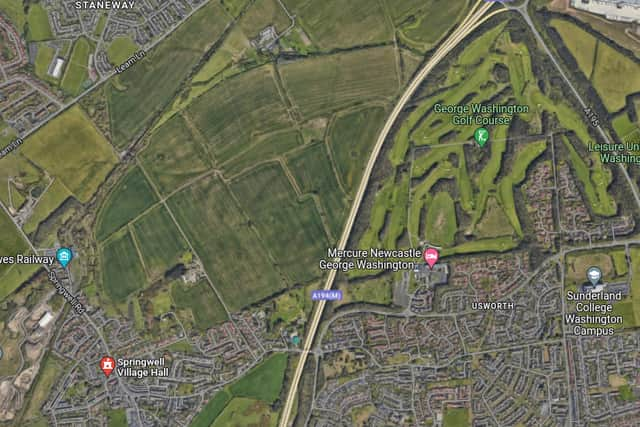

Plans included around 59,319 solar PV panels and PV modules mounted on metal racks and laid out in multiple arrays, along with a substation compound housing “transformer and switchgear infrastructure and tower structures."
According to a design and access statement from the applicant, the solar farm would have provided an output of up to 27.3 MW and could “generate clean renewable energy for the equivalent of more than 11,000 homes a year”.
Applicants were seeking an ‘operational lifespan’ of 40 years for the solar farm, and said the site would then be decommissioned and “reinstated back to the original state before construction."
As most of the site lies within a wildlife corridor, landscaping and “biodiversity enhancements” were also proposed to reduce the ecological impacts of the development, including new planting, hedgerow creation and additional nesting and refuge/overwintering habitat for wildlife.
During a council consultation exercise the solar farm plan sparked public opposition, with around 443 objections raising concerns about issues ranging from “encroachment into and inappropriate development / overdevelopment of Green Belt” and landscape and visual impacts, to highway safety, residential amenity and wildlife impacts.
Some objectors suggested alternative sites for the solar farm, including former industrial areas and ‘brownfield’ land, while other concerns included the proposed development “merging Springwell Village with nearby settlements, taking away countryside [...] and interfering with the setting and character of the village."
In the same council consultation exercise on the solar farm, there were around 32 representations in support with comments noting the renewable energy benefits, as well as the solar farm being “much better than housing” and solar power itself being an “inexpensive and effective measure.”
Sunderland City Council's Planning and Highways Committee discussed the plans at a crunch meeting on January 6, 2025, at City Hall, where a Boom Power Ltd representative acknowledged the development was in a “sensitive location” and that local people had raised “valid concerns”.
However, developers said the siting of solar farms had to strike a balance between placing developments near available grid connections, and homes that use energy, while avoiding “undue impacts” and that Green Belt sites needed to be considered to meet national net zero and energy security targets.
After being put to the vote, councillors on the Planning and Highways Committee rejected the application against the advice of council planning officers, who had recommended the solar farm for approval.
There were concerns that the solar farm plan clashed with several of the council’s own planning policies, including those linked to the Green Belt and safeguarding the countryside from encroachment.
Boom Power Ltd later lodged an appeal against the council refusal and a planning inspector was appointed by the Secretary of State to rule on the planning application.
In an appeal decision report published on October 31, 2025, it has been confirmed that the planning inspector has dismissed the appeal and upheld the council's original decision to refuse the solar farm.
The planning inspector acknowledged the proposal would have "a number of important benefits", including "generating a substantial amount of energy from a renewable source" and would align with national planning objectives around "reducing greenhouse gas emissions and helping to support the transition to net zero by 2050".
However, the planning inspector said the location of the proposed development "plays an exceptionally important role in maintaining acoherent settlement structure within the Tyne and Wear area, providing a green breathing space and separating major areas of development".
It was argued that the land "strongly fulfils three of the five purposes of the Green Belt: to check the unrestricted sprawl of large built-up areas; to prevent neighbouring towns merging into one another; and to assist in safeguarding the countryside from encroachment".
Due to the site being "surrounded by major urban areas", including "Sunderland, Washington, South Shields and parts of Tyneside", the planning inspector said the "integrity of this part of the Green Belt
is very vulnerable to incursion and encroachment by development, including the kind of scheme now proposed".
The planning inspector judged the proposed solar farm to be "inappropriate development in the Green Belt" and said it would "cause significant harm to the openness of the Green Belt and undermine its integrity".
This included the proposed solar farm "occupying a substantial and very visible part of the gap between the urban areas [and] replacing open, green agricultural land with extensive areas of manufactured structures for a period of 40 years", which would "appear as development sprawl andencroachment into the Green Belt".
The planning inspector, on landscape and visual impact matters, said the site was a "pleasant area of countryside, referred to as the Springwell Rise Landscape Character Area" and a "valuable open asset for the people who live in Springwell and the surrounding urban areas".
There were concerns from the planning inspector that the proposed solar installation would "harm the character of this landscape and its value asopen countryside" and "spoil the recreational value of the footpath network", as well as "causing the loss of productive agricultural land for 40years".
The appeal decision report adds: "In conclusion, it is acknowledged that the scheme would bring significant benefits in renewable energy production and would support the objective of reducing carbon emissions and moving towards net zero.
"However, it would amount to inappropriate development in the Green Belt, and it would cause significant harm to the openness and integrity of a particularly vulnerable part of the Green Belt, which in this location plays an important role in separating settlements and avoiding encroachment and sprawl.
"The scheme would also harm the character of the landscape and the enjoyment of the countryside and footpath network, and would cause the loss of productive agricultural land.
"The harm caused by the development would significantly outweigh the benefits and in consequence, the development would conflict with Sunderland Core Strategy Development Plan Policy NE6.
"Very special circumstances do not exist to allow this inappropriate development in the Green Belt."
The full appeal decision report has been published on the Planning Inspectorate’s website.