
South Tyneside: Bid unveiled for new network of modern payphones with defibrillators and touchscreen maps
Plans to install a new network of “communications kiosks” in South Tyneside with “integrated defibrillators” have been submitted to council planning chiefs.
South Tyneside Council’s planning department has received four applications from NWP Street Ltd seeking permission for a “network of communication kiosks.”
The kiosks are planned for land outside the Iona Club in Station Road, Hebburn, and at three locations in South Shields, namely King Street, Western Approach and land near Smithy Street.
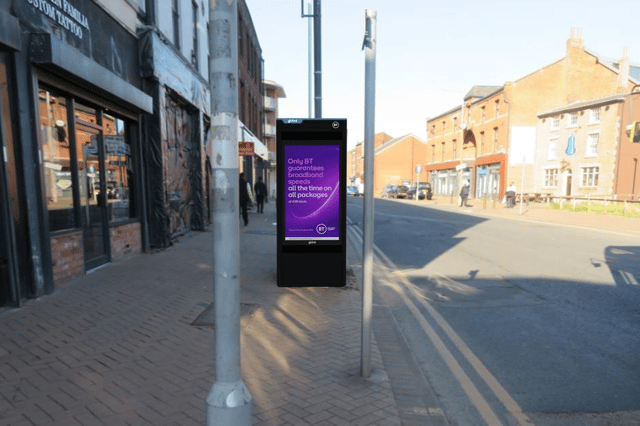

Planning listings for the four locations state that each communications kiosk, effectively a form of public payphone with digital and accessibility upgrades, would have an “integrated defibrillator.”
A supporting planning statement notes that “public call boxes can provide a safety net for people without access to a landline or working mobile phone” and that “in areas with poor mobile coverage, a public call box can be the only option for making calls, including to the emergency services”.
It was noted that the applicant is “modernising its telephone kiosk estate across the United Kingdom” and aims to “upgrade and adapt the communication kiosk to allow a base level coverage provision across urban areas fit for the 21st century”.
This includes a “new modern design” set within a stainless steel structure “reflecting the instantly recognisable telephone kiosk heritage, ensuring it provides open access for all”.
Those behind the scheme said the kiosks would be a “multi-communication hub for the future”, each with a telephone along with “touchscreen information to assist users with wayfinding / mapping information”.
It was also noted that the “telephone itself will allow for debit & credit card and contactless payments” and that “to provide additional connectivity, small cell access nodes will be available in kiosks where they are able to be housed”.
Applicants said “other location-based information may be included including NFC and Bluetooth, with ability to modernise provisions with the most up to date generation technology as it progresses”.
In addition, the “kiosk design will integrate a digital screen to the reverse of the structure, smartening its image,” planning documents state.
The planning statement adds: “The communications kiosk is purposefully ‘open plan’ to enable an inclusive and open access to all users, including those with mobility impairments.
“Further, the exposed nature of the proposed kiosk supports natural surveillance due eradicating the enclosed space and removing the doors.
“Therefore, the kiosk inherently supports design out crime aims and the reduction in anti-social behaviour linked with these types of facilities.
“The internal lighting provides the necessary illumination for the operation of the telephony unit and a well-lit, secure space for users.
“The over-head canopy roof and glazed side panel provide those operating the kiosk with shelter from the elements and shielding from road noise alongside.”
Planning documents also confirm that “NWP is partnered with a charity working to support communities in the provision of defibrillators”, and that defibrillators would be integrated into the communications kiosks.
It was noted that “once installed, the defibrillator would be registered on the national defibrillator network, known as The Circuit […] thereby ensuring its precise location is known to ambulance services”.
The planning statement adds: “The joint application for planning permission and advertisement consent for the installation of communication kiosks within South Tyneside Council’s [area] will provide significant public benefit.
“The kiosks will be constructed with durable materials while touching upon the design heritage of Britain to provide a useful and attractive element of street furniture.
“The public benefit of providing telecommunication with a base level coverage enhances the streetscape and living and working environment.
“The provision of accessible telecommunications is incredibly important for all, but especially the most vulnerable, especially in urban areas where access to services can be limited.
“Through the provision of the communication kiosks, the applicant, in partnership with Trees for Cities, believes the proposal supports policies set out at national and local level in creating a sustainable development, through economic, social, and environmental benefits, which will enhance the local area.”
Decisions on the planning applications are expected following a council consultation exercise.
For more information on the communications kiosks plan, visit South Tyneside Council’s planning portal website.
For the latest public notices from your area, please visit: https://publicnoticeportal.uk/