
'Golden age' - South Shields museum follows up Monet success with new masterpiece
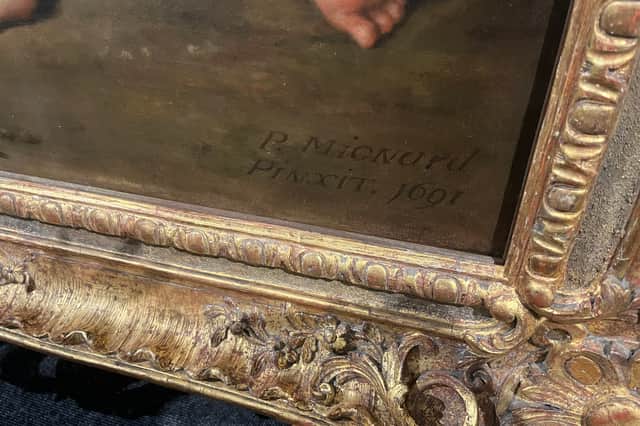
Renowned French painter Pierre Mignard’s giant 1691 work The Marquise de Seignelay has gone on display at South Shields Museum & Art Gallery.
A stunningly colourful painting depicting power, privilege, love and loss – and flawless in brush stroke after 335 years – is set to beguile South Tyneside art lovers.
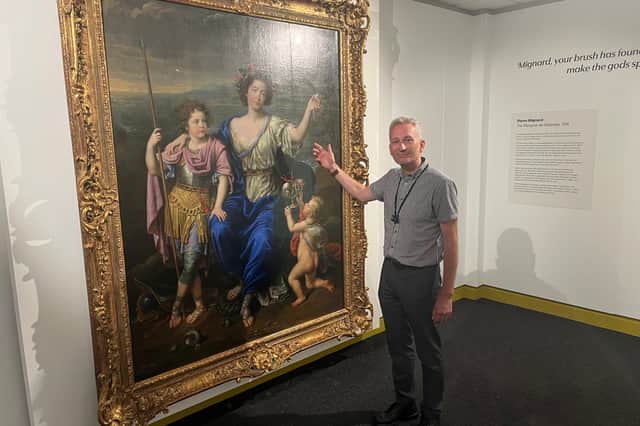

Renowned but largely overlooked 17th Century French painter Pierre Mignard’s giant 1691 work The Marquise de Seignelay has gone on display at South Shields Museum & Art Gallery.
It reveals the recently widowed Marquise in a then fashionable mythological setting, draped in beautiful finery, her son and love’s favourite Cupid by her side.
Behind them is an erupting volcano which experts say may reflect her emotional turmoil over her husband’s death, mixed with her desire and need for a new partner.
In the roughly 5ft by 6ft master work, her clothing is partly in ultramarine from a pigment that at the time was more valuable than gold.
The piece is the second of three to be loaned by the National Gallery as part of its countrywide Masterpiece Tour.
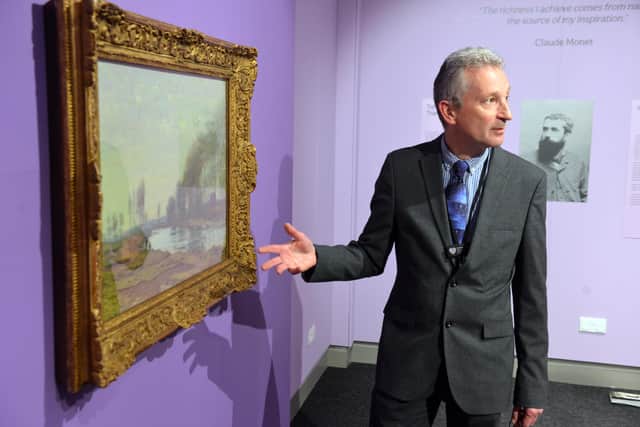
It is hanging where Claude Monet’s 1872 The Petit Bras of the Seine at Argenteuil took centre stage in January, as the first in the series.
The free exhibition, which opened on Saturday (NOTE - Aug 29) and runs until November 7, is named Mignard: The Power of Posing.
It explores the power of portraiture and how artists use pose, clothing, expression and setting to communicate identity, status and personality.
Museum manager Geoff Woodward said the painting showed past and present turmoil and hope for the future - and so much more - brought together in imagined but highly vivid scenery.
He said: “Pierre Mignard was one of the most outstanding painters in 17th Century France, the golden age of culture in literature, music and art.
“This was at the end of the century, when Mignard had been made first painter to the king, Louis 14th.
“Mignard was the person to go to, to get your portrait painted. It’s a big, lavish painting.
“At the time, you couldn’t take a selfie on your phone. To get your portrait painted was a big thing and an expensive thing, especially on this scale.”
Geoff added: “It was very much about image and presentation and status. It’s quite a complex painting. Her husband had died the previous year.
“We’re not sure if it was commissioned by her husband, who was a great admirer of the work of Mignard, or by her.
“We know that after her husband died she was distraught, but she was also keen to find a new husband and a new name.
“It’s one of the paintings from the National Gallery that is one of the favourites with visitors.
“Mignard is not a well-known painter, but it’s a large and stunning painting and there’s a lot going on. It’s richly produced.”
For all its beauty, the painting hides a darker side of life at the time for the Marquise and her family – that of slavery.
Her husband’s family was involved in the slave trade and owned sugar plantations, a means of their wealth.
Geoff revealed: “The slaves were treated really badly. It’s important to think of where some of that wealth came from. It’s important to consider that.”
Visitors can also discover a collection of original poetry inspired by the Marquise and created by young people as part of a sensory writing competition.
And the exhibition features an interactive Selfie Station, inviting visitors to explore a wardrobe of costumes and accessories and transform themselves into a living masterpiece.