
10 questions everyone asks about Invisalign - answered

Does it hurt? Can you still drink coffee? Are adults more excited than teenagers? Invisalign expert Dr Guy Deeming answers the questions people really want to ask about Invisalign, the discreet alternative to metal braces and radical cosmetic dentistry like veneers.
1. What sets Invisalign apart from other teeth-straightening methods?
“In very simple terms, Invisalign is the longest-established clear aligner for straightening teeth. It’s now approaching 30 years old, and with that comes a huge legacy of research and development.


“The sophistication of the product, the laboratory research behind it, the development of the aligner material itself, and the sheer depth of academic evidence supporting Invisalign all mean that, in my clinical view, it stands head and shoulders above much of the competition.
“Following on from that, one of the biggest misconceptions is that all clear aligners are the same - and they categorically are not.
“It’s a little like saying all red liquid in a bottle is the same red wine. It simply isn’t true.
“When patients choose Invisalign treatment - or indeed any orthodontic treatment - they are choosing far more than a product. They are choosing expertise.”
2. Is Invisalign treatment painful?
“It’s a medical treatment, so naturally there can be some discomfort at times.
“The way I often describe it to patients is like wearing a brand-new pair of Dr Martens boots. They can feel snug, awkward, and a little uncomfortable at first, and they may rub slightly during the first few days or weeks. But very quickly, they begin to feel normal.
“So, is it painful? Generally, no. Is it a little uncomfortable at times? Yes, it can be. Does it take a little getting used to? Absolutely.
“For the vast majority of patients, Invisalign is a very straightforward treatment with significantly less intrusion into daily life, comfort, and scheduling compared with conventional braces.”
3. Do patients have to give up things like coffee, wine, snacking, or chewing gum?
“Patients do need to remove their aligners for meals and when cleaning their teeth, but beyond that there’s quite a lot of flexibility.
“I’m generally very happy for patients to drink cool drinks while wearing aligners, particularly drinks without lots of sugar or colouring.
“Even with coffee or red wine, many patients wearing weekly aligners experience very little staining, which is a testament to the quality of the Invisalign material.
“So no - most patients don’t really have to give anything up completely. They may simply need to adjust the timing or frequency of certain habits.”
4. Can you recognise when patients have been “cheating” with their aligners?
“Oh yes - there are lots of little red flags.
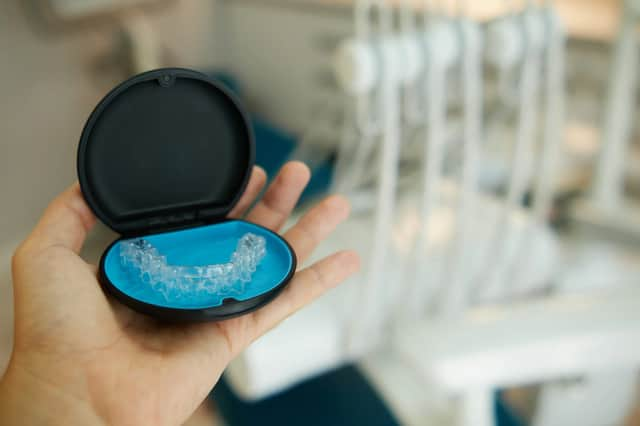
“One of the biggest is when a patient says, ‘Oh, I haven’t got my aligners in - they’re in the car.’ If they haven’t remembered to wear them to the appointment with the person supervising their treatment, that’s usually not a great sign.
“You can also tell from the fit of the aligners. If there are multiple areas where the aligners aren’t fitting properly - little gaps around lots of teeth - that’s often a sign they haven’t been worn consistently.
“More and more these days, I find that having a really open conversation right at the start about compliance and lifestyle makes a huge difference.
“So yes - you absolutely can tell when someone isn’t wearing their aligners properly. Sometimes it’s simply a look in their eye.”
5. Can straightening your teeth improve confidence at work or socially?
“This is an area receiving increasing research attention, and the evidence is growing that, yes, in certain circumstances it absolutely can.
“People who feel unhappy with their teeth often develop coping mechanisms over many years. We all know people who hide their smile, cover their mouth when they laugh, or avoid smiling with their teeth altogether.
“That’s rarely accidental - it’s often a learned behaviour developed through self-consciousness.
“And if smiling freely affects how you feel socially and professionally, then naturally improving that confidence can have a very meaningful impact.”
6. Can straightening your teeth with Invisalign improve long-term oral health, and not just appearance?
“The most obvious benefit for many patients is cosmetic improvement - how their smile looks and how they feel about it. I actually think the importance of self-confidence is often underestimated in traditional healthcare.
“But orthodontic treatment is not just about appearance.
“Straight teeth are generally easier to clean. It is certainly possible to clean crowded or irregular teeth, but it’s much harder work, so if there’s a way to improve your smile while also making oral hygiene easier, that’s obviously beneficial.
“Orthodontic treatment can also help create the correct conditions for restorative dentistry such as implants, veneers, or crowns, particularly where teeth are poorly aligned.
“So there’s a whole range of benefits people can experience with orthodontic treatment.”
7. Do adults get more excited about straight teeth than teenagers these days?
“Potentially, yes.
“Many adults grew up in an era when orthodontic treatment simply meant fixed braces, and braces were considered very uncool - whether that was in the 60s, 70s, 80s, or even 90s.
“Teenagers are certainly grateful for treatment and appreciate the benefits, but adults often have particularly emotional stories because many have waited years - sometimes decades - before finally feeling able to pursue treatment.
“By offering a discreet alternative, Invisalign opens the door for many more adults to achieve the smile they’ve always wanted.”
8. Is there an age limit for Invisalign?
“No - there really isn’t.
“We’re increasingly treating younger patients in what’s called the developing dentition phase - children aged seven, eight, nine, or ten - using systems such as Invisalign First for interceptive or Phase 1 treatment.
“At the other end of the spectrum, I’ve treated patients well into their 80s with Invisalign and would happily do so again.
“Helping someone who has spent 80 years disliking their teeth is an incredibly rewarding thing to do.”
9. What is the most dramatic transformation you’ve seen with Invisalign?
“I’ve been involved with Invisalign for nearly 20 years, and when we first started, treatment was generally limited to relatively mild cases.
“That has changed enormously.
“Today, Invisalign is used to treat cases that are every bit as complex as those traditionally managed with fixed braces - including impacted teeth, severe crowding, and teeth protruding by 10, 11, or even 12 millimetres.
“There are countless examples from clinicians all over the world where Invisalign has been completely transformative, not just aesthetically, but also in terms of function and oral health.
“The idea that Invisalign is somehow a second-tier alternative to fixed braces is now very outdated.”
10. If you could give every first-time Invisalign patient one golden rule, what would it be?
“Recognise that you are not simply buying Invisalign plastic.
“You are buying orthodontic treatment from an experienced clinician using Invisalign aligners.
“Ask questions. How experienced is the clinician? How many similar cases have they treated? How comfortable do you feel with them?
“Because while it’s easy to buy aligners that look similar, the real value lies in the expertise behind the treatment planning.
“Patients need to understand that they are buying treatment, service, care, and professional judgement - and that should come from somebody experienced, trained, trustworthy, and somebody they genuinely feel comfortable with.”
Dr Guy Deeming is a specialist orthodontist and partner at Queensway Orthodontics, Eslington Terrace, Jesmond, Newcastle.