
Kate Osborne MP: Jarrow marchers believed they deserved a better future - I am determined to keep fighting for exactly that
Monday was a very special day for Jarrow, and one that I feel enormously proud to have been part of.
Ninety years after the Jarrow Crusaders marched almost 300 miles to London to demand jobs and a future for their town, I had the privilege of taking their descendants through the doors of 10 Downing Street to meet Prime Minister Andy Burnham.
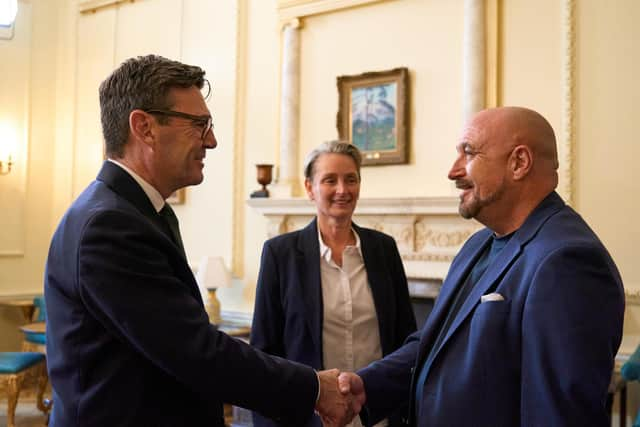

We took with us the original wooden petition box carried by the marchers in 1936, along with a copy of their petition, which we presented to the Prime Minister.
The petition was kindly reproduced by Smith Bros, a local printing firm with its own connection to this history, having printed election posters for my predecessor, Ellen Wilkinson MP.
It was an extraordinary moment to stand in Downing Street alongside the families of those who made that journey 90 years ago.
In 1936, the marchers arrived in London exhausted after weeks on the road, having left behind families struggling with desperate poverty and unemployment. They had walked the length of the country to ask the Government to help save their town, but Prime Minister Stanley Baldwin refused to meet them.
On Monday, their descendants received a very different welcome.
I am incredibly grateful to Andy Burnham for taking the time to meet the families, listen to their stories and recognise the injustice their relatives faced. As the Prime Minister said, we were helping to right a historic wrong, and I know how much that meant to everyone involved.
For me, it was particularly important that the descendants themselves were at the centre of these commemorations. Many have grown up hearing stories about their fathers, grandfathers and great-grandfathers, and their families have helped keep the history of the Crusade alive for generations.
But our visit to Downing Street was only one part of a very busy and memorable day.
Back in Parliament, I had organised an exhibition bringing together original objects, documents and photographs from the 1936 Crusade, with the support of North East Museums and the People's History Museum.
Among the exhibits were a marcher's badge, personal correspondence and items connected to Ellen Wilkinson, who fought so tirelessly for the people of Jarrow.
It was wonderful to see these pieces of our local history displayed in Parliament, particularly with descendants of the marchers there to see them.
We also welcomed local schoolchildren and their families who had taken part in my Jarrow March poetry competition earlier this year.
The competition was one of my favourite parts of the anniversary programme. Hundreds of young people have been learning about what happened in 1936, thinking about the lives of the marchers and writing their own poems about what the Crusade means to them.
Having some of our young winners in Westminster, alongside the families of the original marchers, was a lovely way of bringing different generations together.
The day concluded with a reception in Parliament, where we were joined by descendants, young people, historians, representatives of local organisations and many of those who have helped make this anniversary programme possible.
I want to thank everyone who contributed, particularly the teams at North East Museums and the People's History Museum, Alan Donnelly and the team at Balaena Tyne, and Lumo, who generously helped with travel from the North East.
The commemorations have involved an enormous amount of work over many months, and I am grateful to everyone who has helped us celebrate Jarrow's history in such a fitting way.
Of course, the anniversary has also given us an opportunity to look at how far Jarrow has come in the last 90 years, and what more needs to be done.
The marchers were asking for decent jobs, investment and the chance to provide for their families. Those are things that people in Jarrow, Hebburn and across the North East still rightly expect today.
There is a great deal to be positive about. We have seen renewed investment in shipbuilding and our industrial communities, alongside the Government's work to strengthen employment rights and give working people greater security.
Locally, I am particularly pleased that we have secured the new Jarrow March Next Steps Fund, which will invest £25,000 a year in opportunities for young people over the coming decade.
These are practical ways of supporting the communities the marchers fought for, while giving the next generation opportunities that too many of their predecessors were denied.
Today, I will be leading a debate in Westminster Hall on the 90th anniversary of the Jarrow Crusade. I want to use that opportunity to reflect on the remarkable determination of those 200 men, but also to make the case for continued investment in our region, decent employment and a fairer future for industrial communities.
Ellen Wilkinson and the marchers understood the importance of standing together and making sure their town's voice was heard. That determination is still very much part of Jarrow today.
Monday was a day of immense pride for me as Jarrow's MP, and I hope it was for everyone back home too.
Seeing the original petition box taken into Downing Street, with the descendants of the men who carried it there 90 years ago, is something I will never forget.
Those men made their journey because they believed Jarrow deserved a better future. I am determined to keep fighting for exactly that.