
27 Organisations Call On New Government To Tackle ‘SCANDALOUS’ 16-Year Gap In Life Expectancy
A baby from South Tyneside is now the star of a major campaign highlighting that newborns in parts of the North East of England could live 16 years less than in other parts of the UK. New research reveals people in the North East want the new Government to focus on improving housing, air quality and access to nature/green spaces, to improve the region’s health. Campaigning coalition, Health Equals, launches a new campaign in Gateshead to call on the new Government to fix the stark health inequalities that are cutting thousands of lives short across the UK every year.
Campaigning coalition, Health Equals, launches a new campaign in Gateshead to call on the new Government to fix the stark health inequalities that are cutting thousands of lives short across the UK every year.
In parts of the North East, life expectancy is 16 years lower than in some other parts of the UK, and evidence shows that health inequalities are getting worse. Currently, factors like income, housing and air quality can cut your life short because of where you’re born in the UK.
Health Equals – a coalition of 27 organisations including Mind, the British Red Cross, Citizens Advice Bureau, Shelter, Crisis, the Joseph Rowntree Foundation and more – has launched the #MakeHealthEqual campaign because more than 1 in 5 children in the North East live in poverty1, nearly a third (32%) of people in the North East do not have enough money to live well2 and air pollution in the North East is too high, with the level of fine particle pollution breaching the World Health Organisation’s healthy levels3.
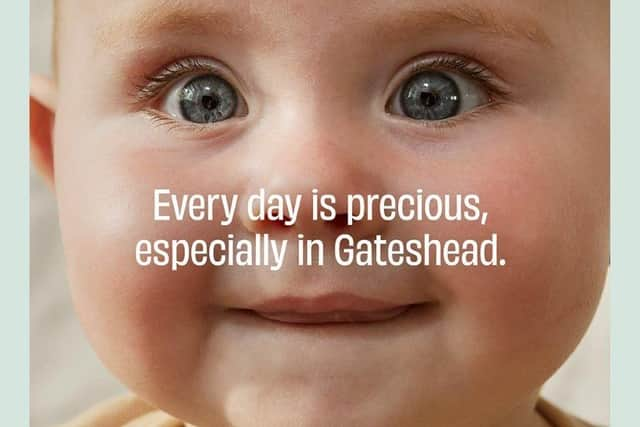

To shine a spotlight on the issue of health inequalities, Health Equals photographed 50 babies to illustrate the shocking range of life expectancies across different towns and cities in the UK.
One of these babies, from South Tyneside, is currently featuring in advertising across the region, to raise awareness of the stark health inequalities that need to be addressed.
According to new research commissioned by Health Equals, when asked what people would like to see the new Government take action on to improve health, nearly half (47%) of people in the North East selected ‘more affordable, quality housing’, 43% chose ‘improving air quality and access to nature/green spaces’ and a third (33%) selected ‘access to healthy food’. When asked what is currently having the most negative impact on their health, a third (33%) selected low income, followed by an unhealthy diet at 27%.
Sarah Gorman, Chief Executive of Edberts House’s Children, Young People and Families (CYPF), who provide prevention and early intervention support to families in East Gateshead, comments on how working in tandem with doctors in the local area has improved the health of the local community:
“When Edberts House began in 2009, there were lots of issues in our local area, exacerbated by the fact that the impact of austerity meant that the local authority wasn’t able to offer the services that it had once provided.
“People quickly began sharing about challenges they were facing: poor housing, debt, financial worries, lack of transport and employment, and loneliness. Lots of people were going to the GP to seek support with these things. They often stated that they had mental health problems, however lots of their problems were actually quite natural anxiety caused by the difficulties in the wider circumstances of their lives.
“When we went to talk to the local GP’s about our work, they realised that some of their patients were involved at Edberts. Doctors commented that people who were regularly involved didn’t attend the surgery so much anymore, and when they did attend, they were more articulate about their health problems. So we worked together to launch our Community Linking Project – a team based in the GP’s who could support people around the wider determinants of their health.
Academic analysis of our statistical data has confirmed that we are improving the physical and mental wellbeing of our local communities by addressing the wider determinants of their health.”
Alex, aged 18, grew up on the Longbenton estate in Newcastle, and has struggled with a combination of social anxiety, isolation and fear of others from a young age, which presented barriers to employment opportunities. He became involved with Justice Prince CIC’s Barriers to Employment project in April 2023, which has since led to him being appointed into a paid trainee role, and the organisation recognises that good, secure employment is a key building block of health. Part of its wider work tackles poverty and economic exclusion by increasing access to learning, training, education, and employment opportunities for all sectors of the community.
Alex comments: “I never thought in a million years I’d of [sic] done the things I’ve done in this job. It has challenged me, no end, but I’ve always felt supported. I feel proud to be involved, we have achieved a lot.
“We have provided young people with opportunities, some of those people, I felt quite intimated by at first but I realised they were like me, just with different issues to overcome. We all want to work and earn money; nobody wants to be on the dole stuck at home.
“Gaining confidence has helped me be me. I’m still on my personal journey, I have not fully overcome my issues but I know now that I will. I feel good, I feel supported, I’m happier in myself because I have friends, colleagues and family.”
Health Equals also produced a campaign film exploring how two babies, Louis and Lorcan, who grew up in different regions, have stark differences in their life expectancies: https://healthequals.org.uk/make-health-equal/
Health Equals also captured the reactions of more people in Newcastle to the life expectancy discrepancy across the UK: https://healthequals.org.uk/make-health-equal/north-east/
Health Equals is now calling for the new Government to recognise the importance of the building blocks of health – stable jobs and pay, good quality and affordable homes, and neighbourhoods with green spaces and clean air – and make them a priority across Government. The coalition is calling for cross-government action on prevention, targets to be set, and for the Government to be held to account in tackling inequalities and reducing the gap in life expectancy across the UK.
Paul McDonald, Chief Campaigns Officer, Health Equals, said: “It’s scandalous that babies born in parts of the North East could have their lives cut short by up to 16 years compared to other parts of the UK.
“Our health is shaped by the world around us – from the money in our pockets, to quality homes that are warm and safe, stable jobs and neighbourhoods with green space and clean air. But these essential building blocks of good health aren’t available to everyone. While individual choices and access to health care do impact our health, evidence shows these building blocks have a far stronger impact.
“Too many parts of the UK are at risk of being ‘left behind’ without policies that support these building blocks of health and wellbeing. It’s not right but we can change it. The time is now to call on the new Government to Make Health Equal.”
Alice Wiseman, Director of Public Health for Gateshead and Newcastle Councils, said: “Our region has the lowest life expectancy in England, and while it may come to many as a shock that a child born in parts of the North East could have their lives cut short by up to 16 years compared to one born in other parts of the UK, this has been the case for some time. In addition many of our residents live more, of their shorter life, in ill-health.
“Despite having some of the best health and care services in the country we still have stubbornly persistent health inequalities. Improving this position requires action way beyond health and care.
“The impact of the building blocks of health our health and wellbeing cannot be overstated, and we must work together to prioritise them for every adult and child living in the North East. To truly address these inequalities, we need sustainable, long-term funding and a commitment from government to make Health Equal for our communities.”
Councillor Lynne Caffrey, Chair the Gateshead Health and Wellbeing Board, said:
“Every person in Gateshead deserves to live a healthy, fulfilled life. As set out in our Health and Wellbeing Strategy, we recognise the impact that wider determinants of health have on our communities, including access to nutritious foods, good employment, and affordable housing.
“We support the mission to Make Health Equal while promoting the importance of the building blocks of health in ensuring our communities can thrive.”
To keep pressure on the new Government, Health Equals has started a petition – calling on people to ask their MP to commit to tackling health inequalities. For more information and to sign the petition, visit healthequals.org.uk.
Let’s #MakeHealthEqual.
Sources:
-
1 Health Foundation analysis of Office for National Statistics, Life expectancy at birth for Middle layer Super Output Areas, England, 2015-19; Office for National Statistics, Life expectancy estimates, all ages, UK, 2017-19.
-
2 Comparing percentage increase in those who select that ‘income and housing’ are top 3 factors negatively impacting health, between Casual or lowest grade workers, pensioners, and others who depend on the welfare state for their income and Higher managerial, administrative or professional.
-
OHID Fingertips Health Data. Indicator: Air Pollution
Notes:
-
Data for England covers 2015-19 and data for Wales, Scotland and Northern Ireland covers 2017-19.
-
The data provides life expectancies estimated at postcode district level - this is estimated as an estimate of the life expectancies in the relevant Middle layer Super Output Areas/local authorities which lie within a postcode district.
-
Values are an average of male and female life expectancy values in each area.
-
We have taken an average of the 10 postcode districts with the highest life expectancy (90), and the average of the 10 postcode districts with the lowest life expectancy (74). This provides us with our figure of the 16-year gap in life expectancy across the UK.
About Health Equals
Health Equals is a coalition made up of 27 member organisations including charities, think tanks and industry organisations. We are campaigning for action to create a society where each of us has our best chance of good health, no matter who we are or where we are born, work and live.
About Britain’s Youngest Protest
To create Britain's Youngest Protest, Health Equals travelled the country with renowned photographer Emli Bendixen, to photograph 50 babies in 50 homes; a snapshot of the country and a time capsule of our newest generation. Each baby wore a onesie with their hometown written on it, and their photograph was turned into a placard with their life expectancy etched on it. Standing 10 feet tall, and each placard being A0, together the 50 babies create a protest that is hard to ignore.